 FREE SHIPPING ON ORDERS OVER $150 RETAIL (not including taxes)
HOW FISH MAKE FEEDING DECISIONS UNDER THE ICE
Understanding Sight, Sound, Smell, Feel and Taste - and How Anglers Can Trick Fish
You’ve been there. Sitting over a fresh hole, sonar glowing, heart pounding as a solid red mark rises from the bottom. It follows your bait… noses right up to it… but instead of inhaling, the fish stalls — stares — and slowly drifts away. You change cadence. You switch colors. You try bait. You try scent. Still the same story: fish show up, but the bites don’t. Meanwhile, the angler two huts over is quietly stacking a pile of fish. Why does it happen? Under the ice, fish have more time than ever to inspect what’s in front of them. In clear, cold water they judge every detail — especially when they are negative — how real your bait looks, the vibration it gives off, any scent trail it leaves, and even how it feels when they test-bite. One sense out of place… and the whole illusion collapses. But when every sense signals “this is real food,” fish commit. That’s exactly why we built the Strike Sensory System™ — to stack the odds back in your favor and convert lookers into biters.
The STRIKE Sensory System (SSS) is a design framework built around how fish actually decide to eat. Rather than focusing on a single trigger, SSS considers the five natural senses fish use to assess prey: sight, feel, sound, smell, and taste. Each sense plays a role in the decision-making process, and when even one signal feels wrong, the strike often fails.
Our baits are designed from the ground up using this system. Anatomically correct profiles address visual recognition. Precise material blends and vertical tail geometry control hydrodynamics and feel. Subtle vibration supports lateral-line detection. Scent infusion reinforces investigation. Natural mouth feel and taste increases hold time and commitment.
SSS doesn’t stop at the bait itself. We also develop rigging methods and accessories that help anglers maintain or enhance all five sensory cues — ensuring the system remains intact from design to presentation.
The result is not just a bait that attracts attention, but one that passes inspection. When all five senses agree, fish don’t hesitate. They commit.
FISH SENSES BREAKDOWN
Why It Matters to Attract All Five Senses
SIGHT
Fish rely heavily on visual cues:
Accurate body profile
Correct proportions
Realistic eyes
Natural and reactive colour patterns
This is why GRUMPY gobies are anatomically accurate, not stylized — because fish recognize what they eat.
FEEL/TOUCH
Before a fish eats, it feels the bait:
Water displacement
Resistance
Body stiffness
Tail response
Our combination of bait designs, supple materials and accessories balance touch and movement that feels right in the water column.
SOUND/VIBRATION
Sound underwater is vibration:
Tail thump
Goby Bottom Bouncing
Glass rattling
Body roll
Combining GRUMPY Rattles with any of our baits creates sound and vibration that fish detect with their lateral line — especially important in stained water or low-light conditions.
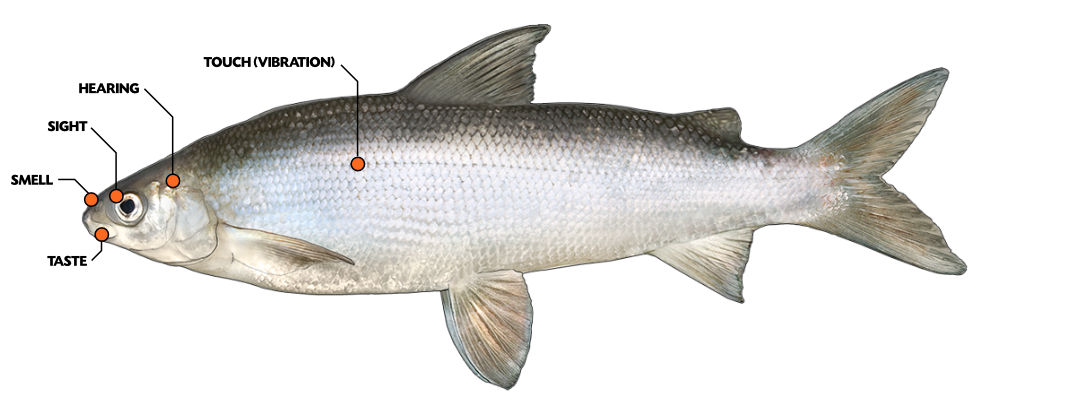
SMELL
Before a fish commits, it often confirms what it sees and feels through scent. Fish detect:
Dissolved chemical cues
Scent trails in the water column
Concentration gradients around a bait
In a vertical presentation — especially when fish are slow, cautious, or neutral — smell becomes a secondary validation step. It allows fish to locate the bait more precisely, remain engaged longer, and reduce hesitation before striking.
TASTE
Once a bait is taken into the mouth, taste determines how long the fish holds on. Fish assess:
Material softness
Mouth feel and texture
Chemical cues (salt)
In many cases — especially with cautious or pressured fish — the strike itself is only part of the process. A bait that feels or tastes unnatural is often rejected immediately, resulting in short strikes or missed hookups.
UNLOCKING ICE FISHING SUCCESS WITH THE STRIKE SENSORY SYSTEM
Why Activating All 5 Fish Senses Leads to More Flags, More Hits, and More Fish On Ice
Ice fishing isn’t open water fishing with a frozen lid — it’s a completely different ecosystem. Anglers drill a hole, drop a bait, and suddenly the search radius shrinks from hundreds of feet to a 2–4 foot strike zone. Fish move slower, feed less, and become more observant.
That means one thing: Every detail matters more than ever.
Predators rely on their five primary senses to detect prey — Sight, Sound, Smell, Taste, and Feel. The Strike Sensory System by GRUMPY Bait Company is engineered to activate every one of those senses, helping you turn cautious lookers into confident strikers.
Let’s break down why…
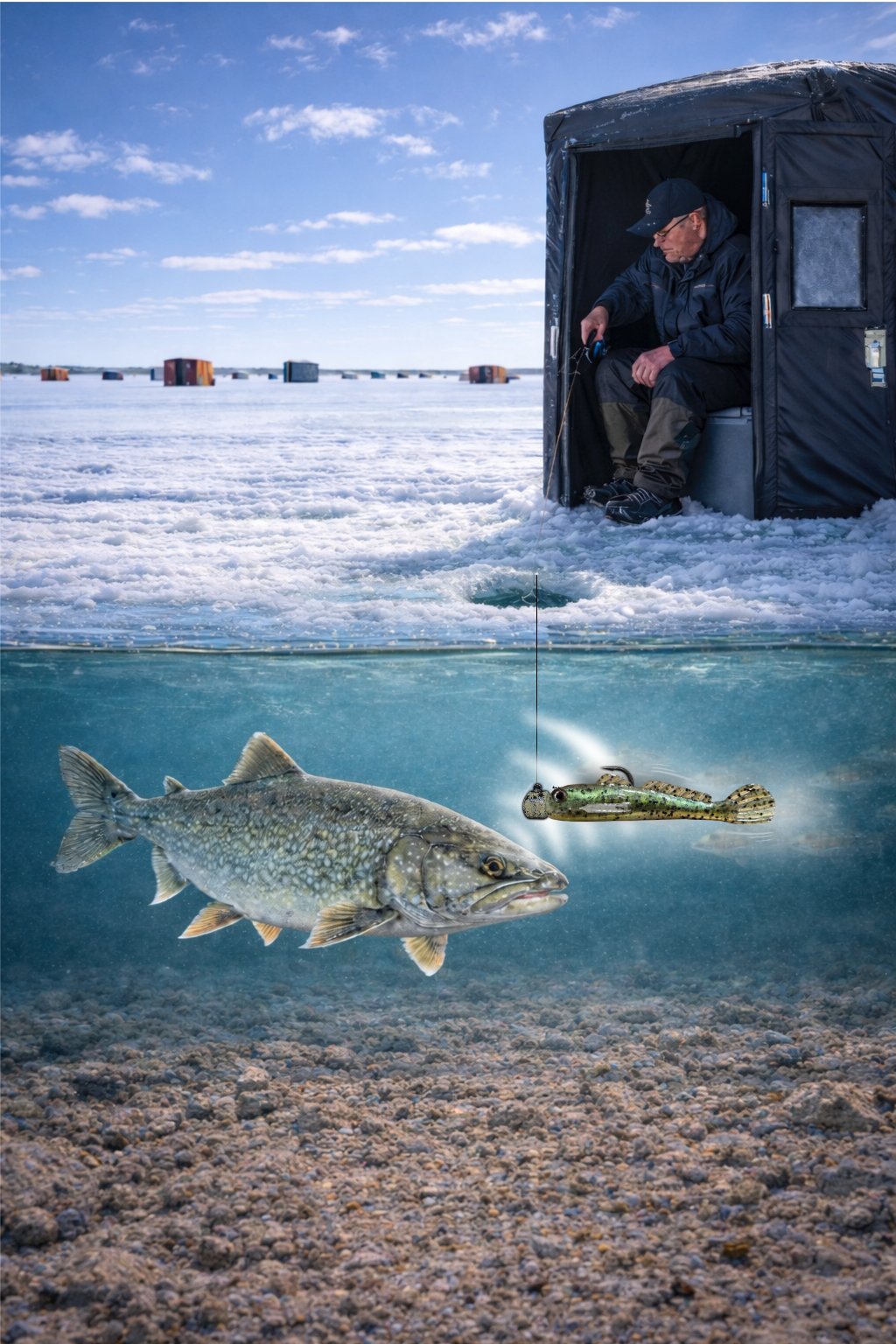
SIGHT – When Lake Trout Put Your Bait Under the Microscope
Under the ice, especially on the Great Lakes, the water often gets clearer as temperatures drop and algae dies back. For sight-oriented predators like lake trout, walleye, salmon and pike, that’s an advantage. They’re no longer making split-second decisions around moving schools of baitfish; instead, they’re sliding slowly through a quiet, bright winter world where they can study what’s in front of them.
On sonar you see it happen all the time: a trout rises off bottom, moves into your cone, hovers under your bait, then fades away. That isn’t random. That’s a fish running a visual checklist. Is the profile right? Does the tail match what it sees every day on bottom? Do the eyes look like prey or like a piece of plastic? Under ice, these fish can circle, stall, and inspect your bait from multiple angles before they ever think about opening their mouths.
This is where profile accuracy really matters. Fish that feed on round gobies are used to a very specific shape – blunt head, tubular body, belly-dragging posture, two dorsal fins and a vertical caudal fin fanned behind them. A bait that’s too skinny, too tall, or with the wrong tail orientation looks “off” in a hurry. Fish that feed on minnow style baits can focus on the orientation of the caudal fin - which in nature are vertical not horizontal like many fluke and paddletail baits. The same goes for colour: in clear winter water, overly loud colours can actually push pressured fish away, while natural goby browns, olives and mottled backs let your bait disappear into the environment until a light jig brings it to life.
A realistic goby-style soft plastic, like the detailed patterns in our goby series at https://www.grumpybaits.com/goby-series, gives you that correct silhouette and posture so sight-hunters don’t immediately disqualify it. When you’re locked over a single hole with a tiny radius of influence, you can’t afford to lose fish at the very first sense they use. Get sight right, and lake trout, walleye and many other visual feeders are willing to move to the next stage of their decision process instead of simply drifting away.
BAIT: Shown with 3.3" GOLIATH Goby (Lake Simcoe Goby - 020), Grumpy Glass Eyes, 1/4oz Zebra Mussel Jig, Grumpy Glass Rattles, Hammer Juice infused
FACT:
A recent article from Beyond the Cast explains that predators identify prey based on outline and shape first, and that profile determines whether fish feed, often more than colour. It notes that fish of multiple species responded more strongly to lure silhouette and swimming action that matched natural prey — and that the fish hit the lure because the profile matched what they were keyed into, not because of colour alone.
Reference. Beyond The Cast
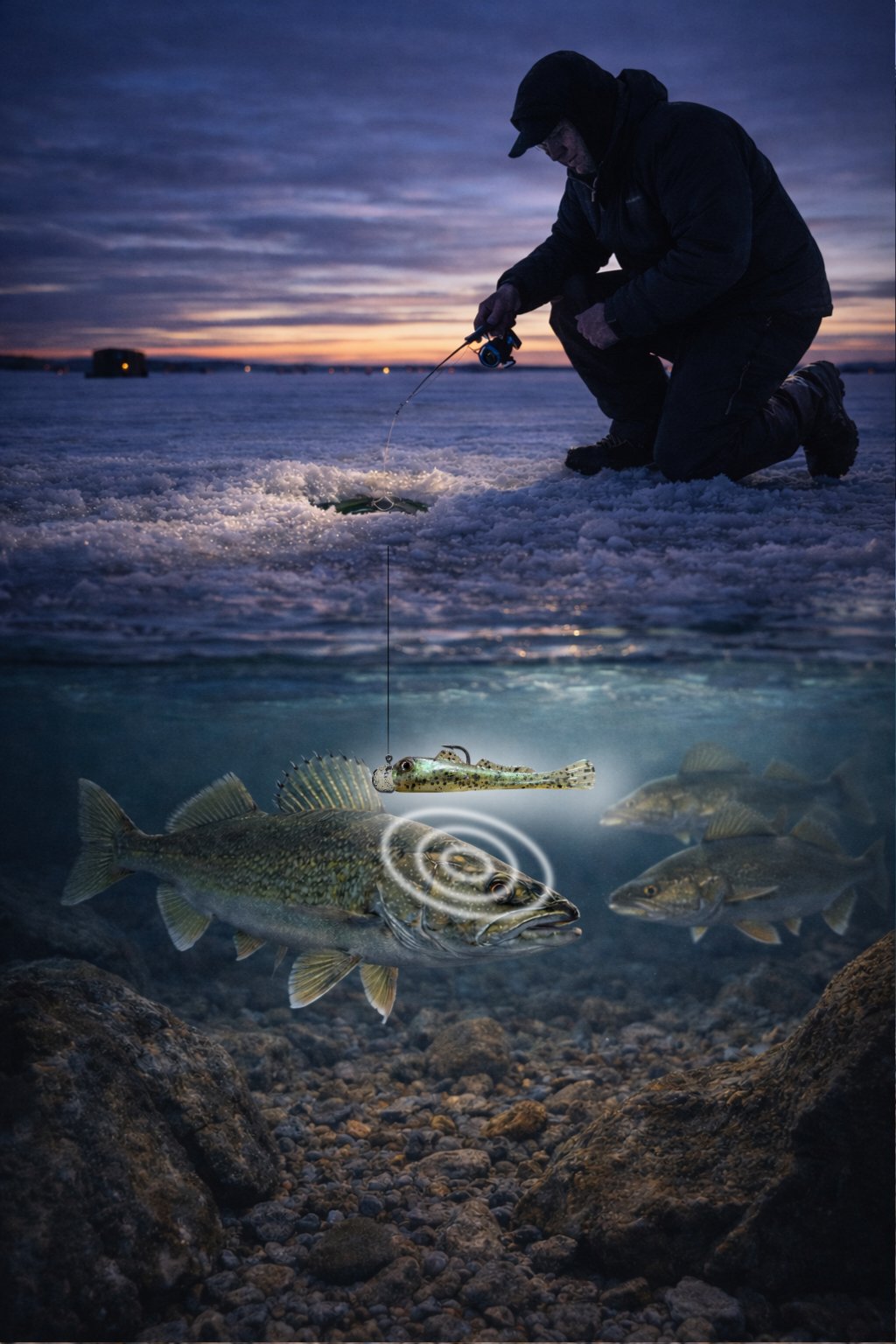
SOUND – How Walleye Find You Before They See You
Ice fishing shrinks the world down to the size of a dinner plate. You’re not covering shoreline or chasing bait balls; you’re working a three-to-five-foot circle beneath a single hole. In that environment, if a walleye never becomes aware of your bait, it will never appear on your screen in the first place.
That’s where sound and vibration matter — and few species demonstrate this better than walleye. Walleye are built to hunt in low light, dirty water, and under ice. Long before they visually lock onto a presentation, they rely on their lateral line and inner ears to detect subtle pressure changes, movement, and vibration along bottom. A faint click, tick, or rattle can be the first signal that something alive is happening nearby.
Under the ice, sound often travels farther and more efficiently than sight. Snow cover, low sun angles, and depth all reduce visibility, but vibration cuts through those limitations. A cruising walleye may never see your bait from a distance, but it can feel it — especially when that bait sends out controlled, deliberate pulses that mimic feeding activity on bottom.
Short, intentional lifts that activate a jig head or rattle chamber, followed by long pauses, create a simple message: movement, life, opportunity. This mirrors how walleye naturally feed, sliding along breaklines, flats, and edges, homing in on vibration first and only committing visually once they’re close.
A compact goby-style bait paired with a small internal glass rattle — the kind of sound-based thinking behind the Strike Sensory System (https://www.grumpybaits.com/rattles) — turns a silent piece of plastic into a detectable signal. The key is restraint. Winter forage isn’t noisy or frantic. Subtle, irregular clicks that feel like a goby shifting on rock or a mussel shell tapping gravel are enough to expand your effective strike zone beyond what sight alone can reach.
Once that vibration pulls a walleye in, it slides into your sonar cone. From there, the interaction becomes a close-range evaluation — and that’s when the next senses take over.
BAIT: Shown with 2.6" ROUND Goby (Lake Simcoe Goby - 020), Grumpy Glass Eyes, 1/8oz Zebra Mussel Jig, Grumpy Glass Rattles, Hammer Juice infused
FACT:
According to In-Fisherman, walleye (and other gamefish) are capable of detecting sound and vibration through a combination of their inner ears, swim bladder, and the lateral line system. These sensory systems allow them to perceive pressure waves and low-frequency underwater sound, which helps them locate prey and respond to environmental cues.
Reference: In Fishermen
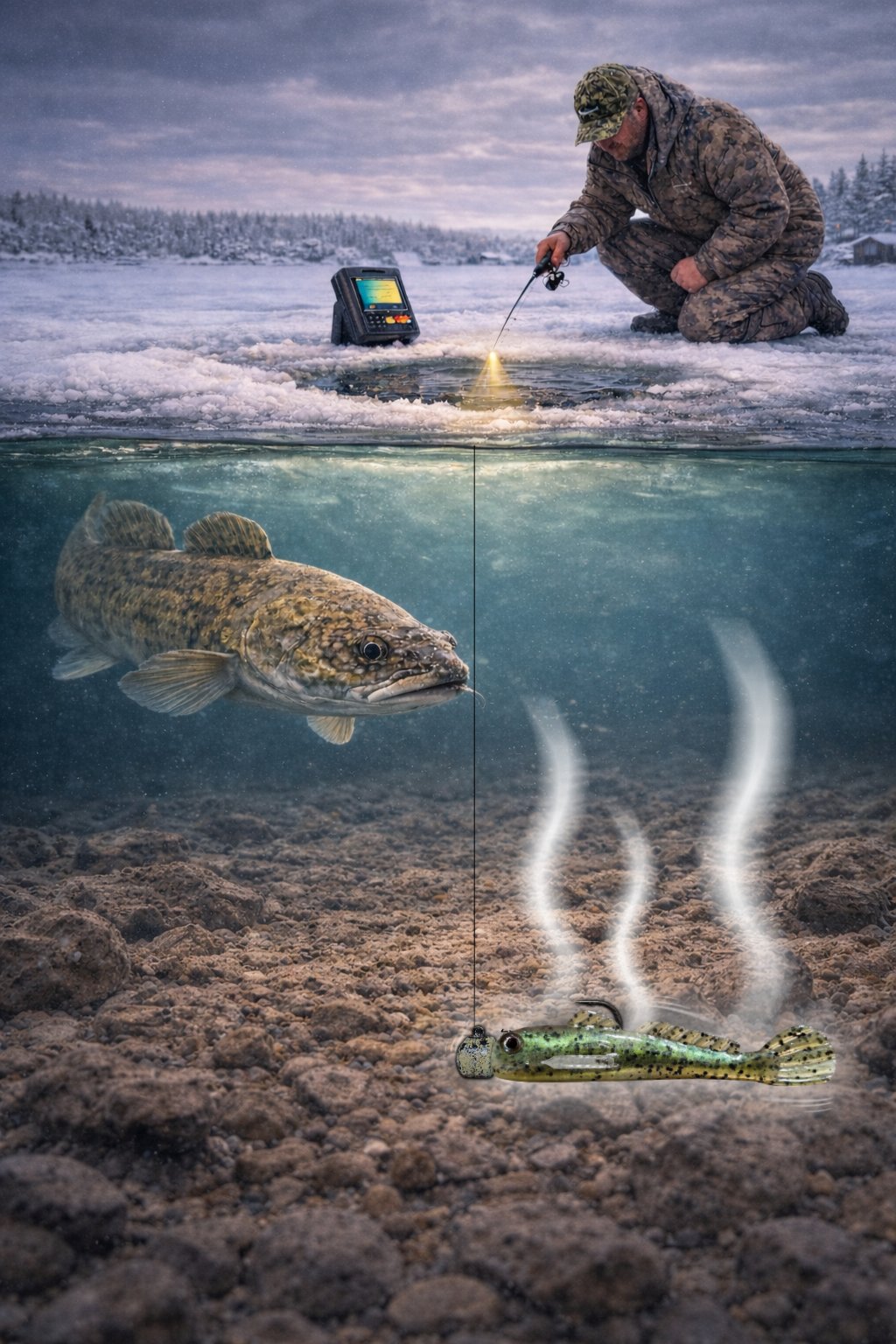
SMELL – Burbot’s Superpower in the Dark Under Ice
If there’s one fish that proves how important smell is in winter, it’s the burbot. These nocturnal, eel-like predators thrive in cold water. They’re built for long, low-light patrols over rock and sand, and they rely heavily on scent to decide what’s worth eating.
Under the ice, current is often minimal. That means any scent in the water forms a slow, lingering scent cloud rather than being blown away. Burbot use this to their advantage, sliding in and out of the dark, following faint trails of odour across structure. They might never “see” your bait from a distance the way a lake trout does, but if your bait is leaking the right smell, they can track it directly to the hole.
This is where many ice presentations quietly fail. On sonar, you’ll see a fish rise from bottom, come in tight, then slowly nosedive away without ever committing. Visually, everything might have been perfect – profile, colour, posture – but when the fish drew close, the scent story didn’t match. Cold plastics with no attractant, baits that have taken on gas or sunscreen odours, or metal that smells foreign will all trigger caution in a burbot’s brain.
Using oils and gels that match what fish already expect to smell – crushed baitfish, goby or invertabrates – dramatically raises the confidence of scent-driven species. When you coat a goby-style bait with a concentrated attractant, like the scent philosophy behind Hammer Juice at https://www.grumpybaits.com/hammer-juice, you’re building a trail that burbot can literally follow right up into your cone. The visual details get them to inspect; the smell tells them this is real food, not just a plastic impostor. On tough nights when nothing else seems to turn marks into bites, scent is often the one sense that flips their decision from “maybe later” to “I’m eating that now.”
BAIT: Shown with 3.3" GOLIATH Goby (Lake Simcoe Goby - 020), Grumpy Glass Eyes, 1/4oz Zebra Mussel Jig, Grumpy Glass Rattles, Hammer Juice infused
FACT:
Burbot are nocturnal, bottom-oriented predators that feed in low-light environments where vision is limited. Fisheries research has shown that in such conditions, fish rely heavily on chemical cues to locate and evaluate prey. Olfaction plays a central role in food detection and feeding behavior for burbot and other cold-water fishes, allowing them to follow scent gradients and confirm prey identity before ingestion.
Reference: Adapted from Freshwater Fishes of Canada (Scott & Crossman, 1973) and Hara, T.J. (1994), Olfaction and Gustation in Fish, Acta Physiologica Scandinavica
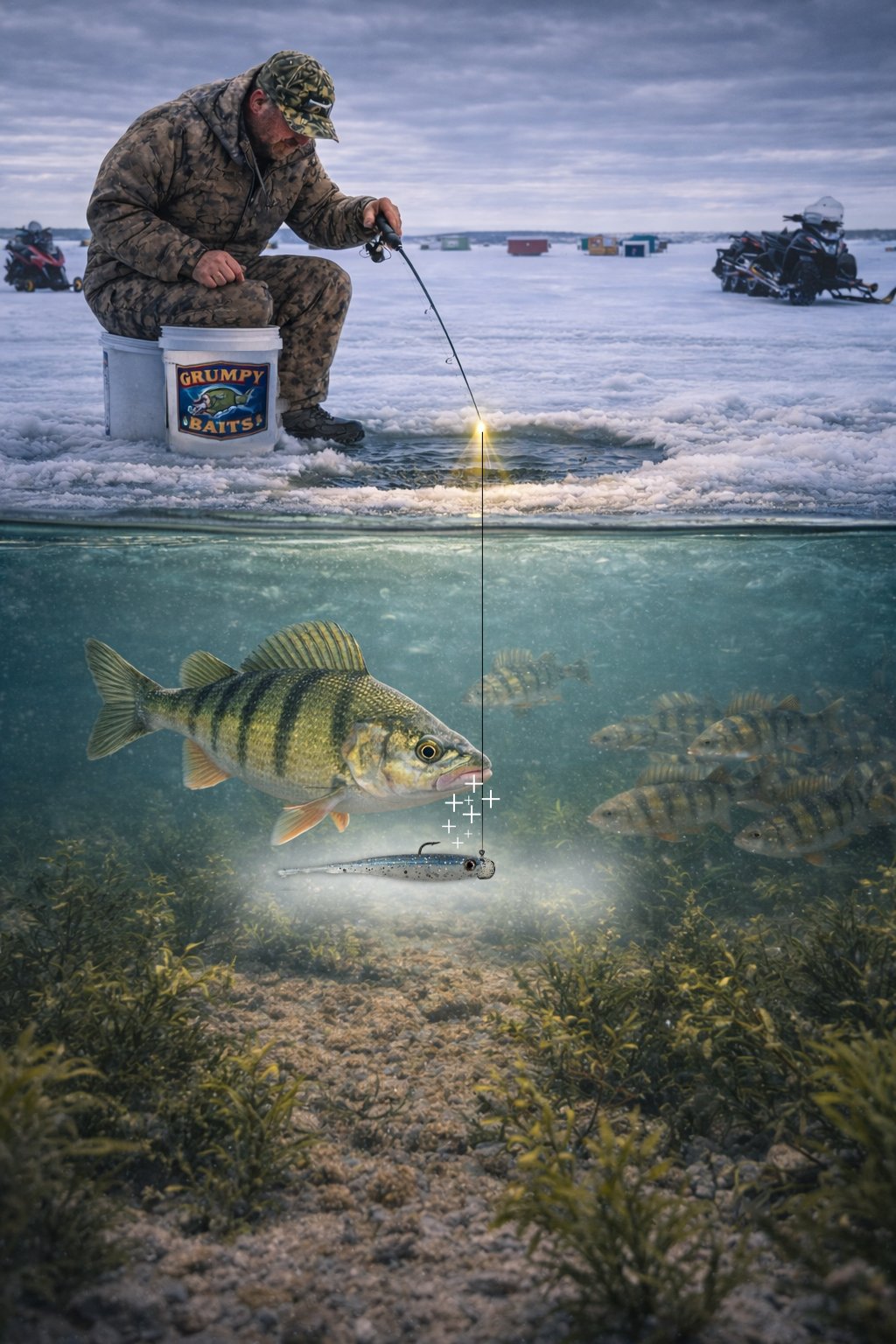
TASTE – Why Jumbo Perch Don’t Forgive Bad First Impressions
If you’ve ever fished for jumbo perch through the ice, you know how picky they can be. One drop, they wolf a bait; the next, they tap, mouth, and spit it faster than you can even react. What’s happening in that split second is a full evaluation of taste and texture.
Perch often feed in groups, and on pressured water they quickly learn the difference between live forage and something that “almost” feels right. They’ll nip the tail, flare their gills to inhale the bait for a heartbeat, and if the flavour and mouthfeel aren’t convincing, they blow it straight back out. Under ice, when you’re typically fishing small plastics or goby imitations close to bottom, that first contact is everything.
Taste has two parts for them. First is the actual flavour – mineral, fishy, salty, something that feels like the flesh and blood they’re used to eating. This is why salt-infused plastics are so effective: that instant saline hit mimics the taste of real prey and encourages them to keep chewing instead of rejecting. Second is texture. Real forage compresses. Gobies, minnows and invertabrates all have a soft, yielding feel when crushed. If your bait is too stiff in cold water, or feels like a solid block, the perch’s brain flags it as wrong and it’s gone before you even see the bite on your rod tip.
Soft goby-shaped plastics or minnow-style baits with internal salt and a supple body – the kind of cold-water-friendly formulation used in GRUMPY Bait Company baits – are designed to prolong that crucial hold time. When a jumbo perch tastes something that feels familiar and compresses like food, it buys you an extra fraction of a second to set the hook. On a tough mid-winter bite, those tiny windows add up. Matching sight and smell might get the perch to sample; getting taste and texture right is what keeps the bait in their mouth long enough for you to win.
BAIT: Shown with 3.3" GOLIATH Goby (Lake Simcoe Goby - 020), Grumpy Glass Eyes, 1/4oz Zebra Mussel Jig, Grumpy Glass Rattles, Hammer Juice infused
FACT:
Many freshwater fish, including yellow perch, rely heavily on taste receptors located in the mouth, lips, and oral cavity to evaluate potential food items. Gustation plays a critical role in the final feeding decision, allowing fish to rapidly detect hardness, texture, and chemical composition once a bait is mouthed. Studies of fish sensory biology show that taste cues strongly influence whether prey is retained or rejected, particularly in cautious, bottom-oriented species and in cold-water conditions where fish frequently test food before committing.
Reference: Adapted from Hara, T.J. (1994) and Kasumyan & Døving (2003), Chemical Senses in Fish, Fish and Fisheries
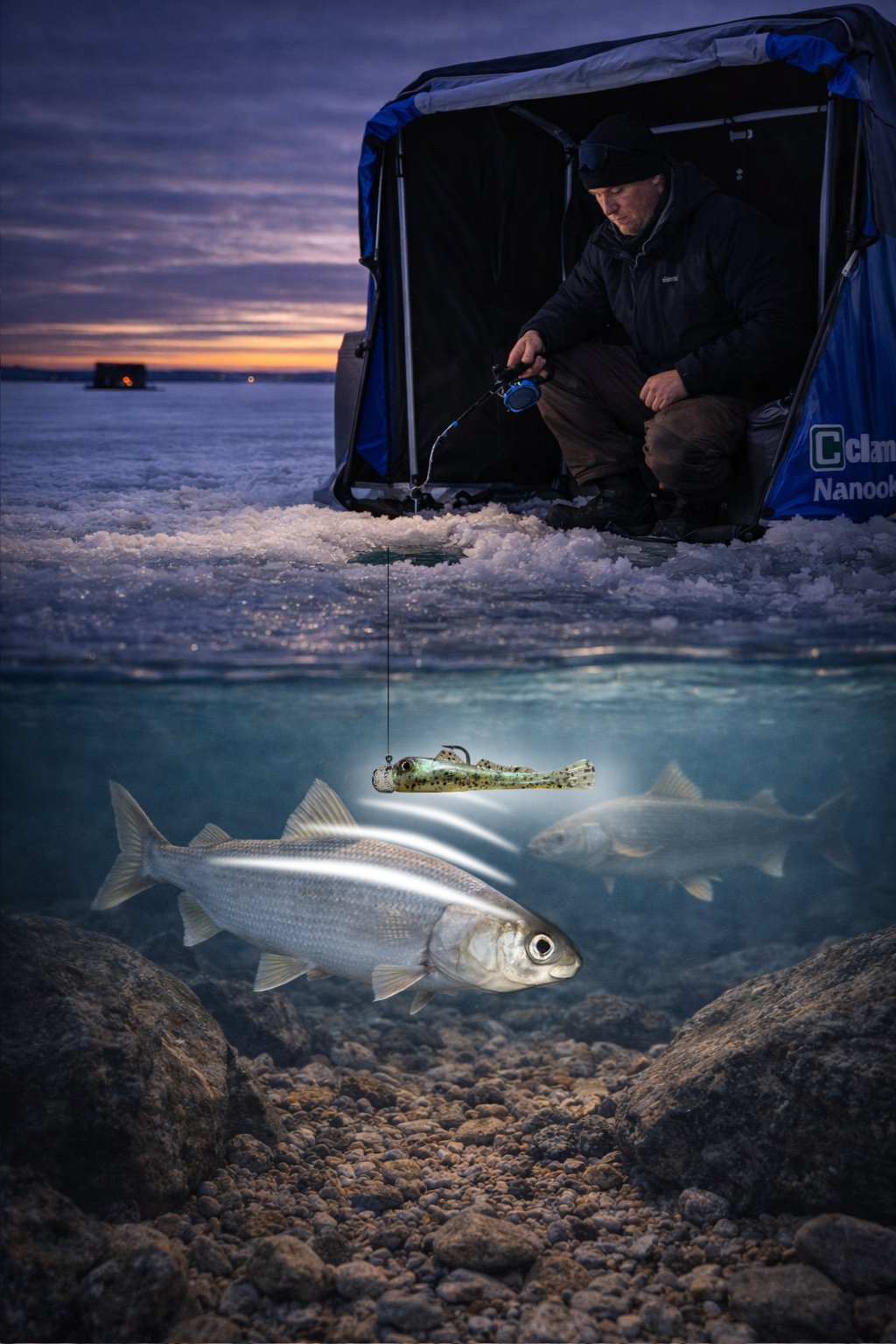
FEEL – The Subtle Sense That Closes the Deal for Lake Whitefish
While we talked about sound as the long-range call for lake whitefish, there’s a second, quieter layer where this species really shines: feel. Whitefish are built with sensitive mouths and a highly tuned lateral line. They don’t just crash prey; they often graze and test along bottom, sifting for mussels, gobies and invertebrates with a combination of pressure and touch.
When a whitefish approaches your bait under the ice, it’s not only seeing and hearing it – it’s also evaluating how the bait moves and feels against the water. Tiny tail micro-vibrations, the way the body resists when you lift, and how the bait settles back to bottom all send information through the lateral line. A stiff, lifeless plastic that doesn’t react to subtle current changes feels wrong long before the fish ever gets it into its mouth.
Once they do mouth it, lip sensitivity takes over. Whitefish can detect hardness, edges and unnatural stiffness almost instantly. In clear winter water where they’re already cautious, that one moment of “this doesn’t feel like prey” is enough to trigger a quick spit. On the flip side, a soft, balanced goby imitation with a jig head that lets it sit nose-down on bottom and rock naturally when tapped feels exactly like what they are used to rooting out – small gobies feeding on zebra mussels.
This is the underlying logic of pairing realistic goby bodies with properly weighted mussel-style jig heads, as done in the jig designs highlighted at https://www.grumpybaits.com/jigs/ned-g-jig. The goal isn’t just to look like a goby feeding on a zebra mussle; it’s to move and resist the way real prey does when bumped or inhaled. When whitefish test the bait with their lips and lateral line, everything they feel matches the script in their brain: soft, compressible, naturally resisting water. That’s the final checkbox. Once feel lines up with sight, sound, smell and taste, there’s nothing left to warn them off – and that’s when hooks find home.
BAIT: Shown with 3.3" GOLIATH Goby (Lake Simcoe Goby - 020), Grumpy Glass Eyes, 1/4oz Zebra Mussel Jig, Grumpy Glass Rattles, Hammer Juice infused
FACT:
Whitefish and other benthic-oriented fishes rely heavily on mechanoreception through the lateral line system to detect water movement, pressure changes, and the physical behavior of prey at close range. The lateral line allows fish to ‘feel’ how an object moves, resists water, and settles on bottom, providing critical information used to evaluate potential food before ingestion. Fisheries research shows that this sense is especially important in cold, clear water and low-light conditions, where fish frequently inspect prey through tactile and hydrodynamic cues rather than vision alone.
Reference: Adapted from Montgomery et al. (2001), The Lateral Line System of Fish, Reviews in Fish Biology and Fisheries, and Scott & Crossman (1973), Freshwater Fishes of Canada
Closing Thoughts
Fish don’t always read the rulebook — and anyone who spends enough time on the ice knows that. There are plenty of days each winter when fish are aggressive, competitive, or simply feeding heavily. First ice, pre-spawn and post-spawn windows, tight forage concentrations, or sudden weather changes can all flip a switch. In those moments, fish often strike out of instinct, curiosity, or competition, and presentations that look nothing like real prey can still produce excellent results.
We don’t believe the Strike Sensory System is the only way to catch fish, nor do we believe realism is always required. Fishing has always been a mix of science, experience, and unpredictability — and that’s part of what keeps it interesting.
Where the Strike Sensory System fits is in those tougher situations: when fish are negative, pressured, or cautious; when they rise, inspect, and fade away; when bites are light and short; and when matching what fish expect to see, feel, hear, smell, and taste can make the difference between a look and a commitment. In those moments, aligning your presentation with natural forage behavior and sensory cues simply makes sense.
Our goal isn’t to replace what already works for you. It’s to offer another tool — one grounded in how fish actually feed — for times when the usual approaches fall short. Fish will always surprise us, and no single bait or system works every day. The Strike Sensory System exists to help anglers experiment with purpose, try something different with confidence, and maybe turn a tough day into a memorable one.
That balance between understanding and unpredictability is what keeps us all drilling holes, tying rigs, and chasing the next bite.
Learn more about GRUMPY Bait Company visit www.grumpybaits.com or email
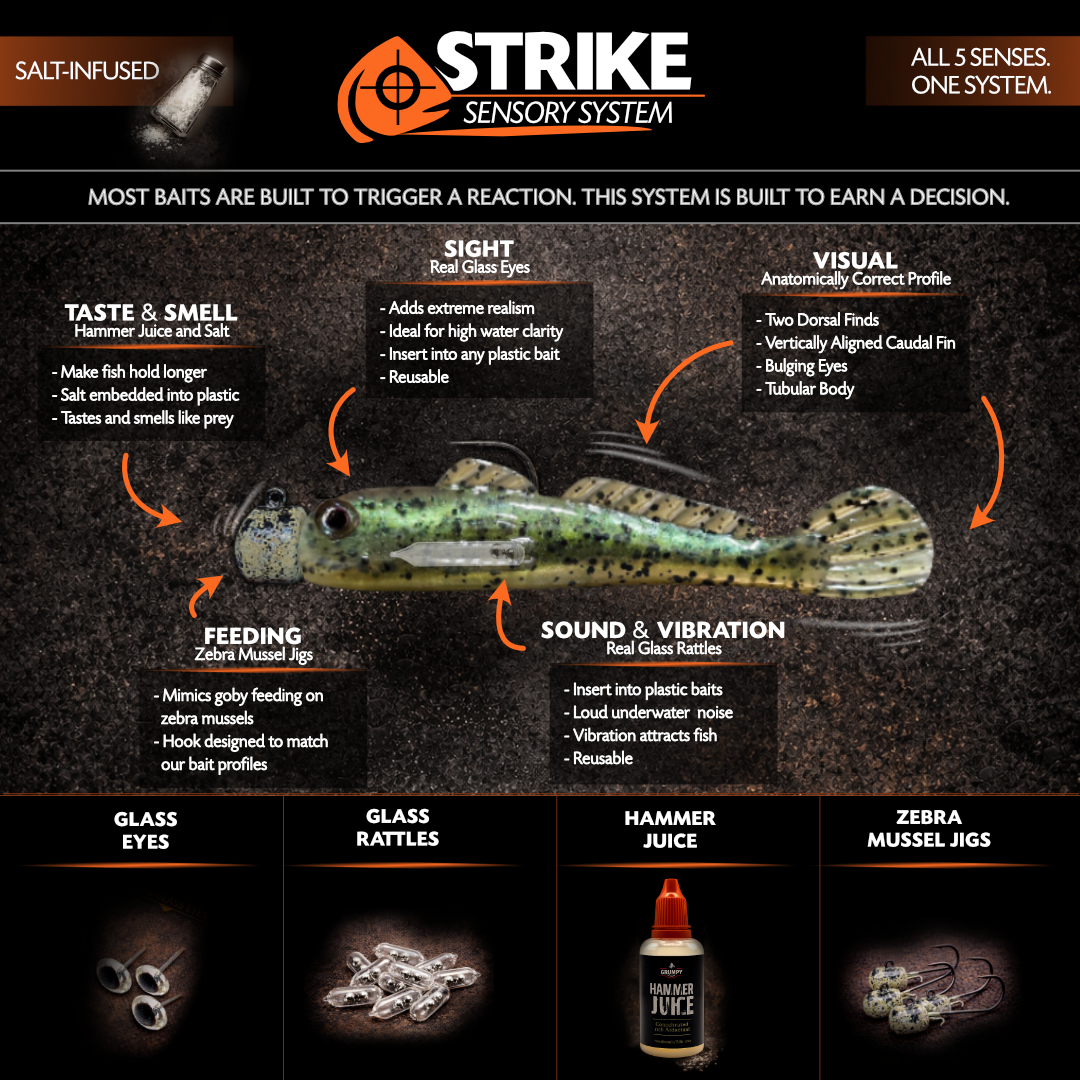
Showing with the 3.3" GOLIATH Goby, Clear GRUMPY Glass Eyes, 16mm GRUMPY Rattles, 1/4oz Zebra Mussel Jig
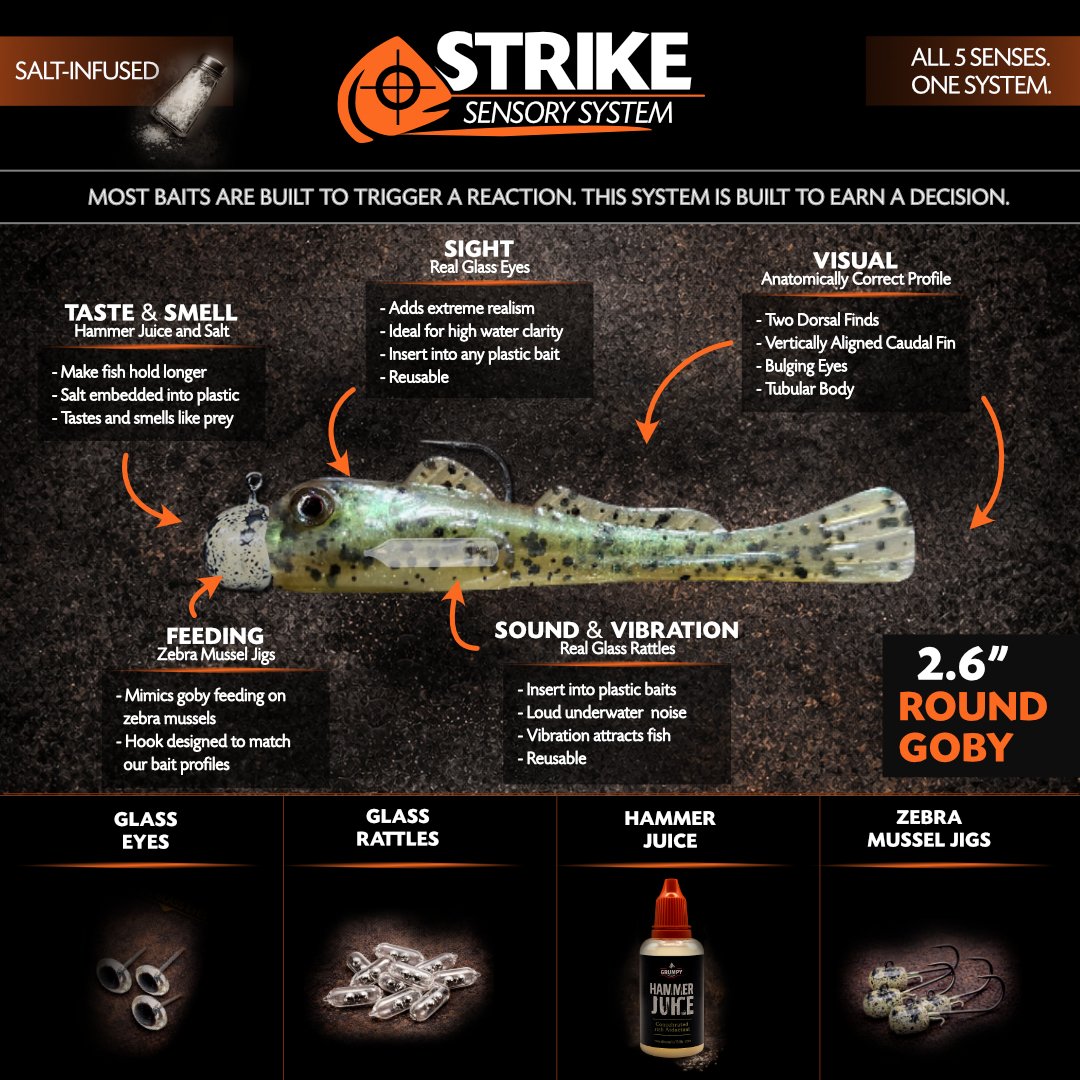
Showing with the 2.6" ROUND Goby, Clear GRUMPY Glass Eyes, 16mm GRUMPY Rattles, 1/8oz Zebra Mussel Jig
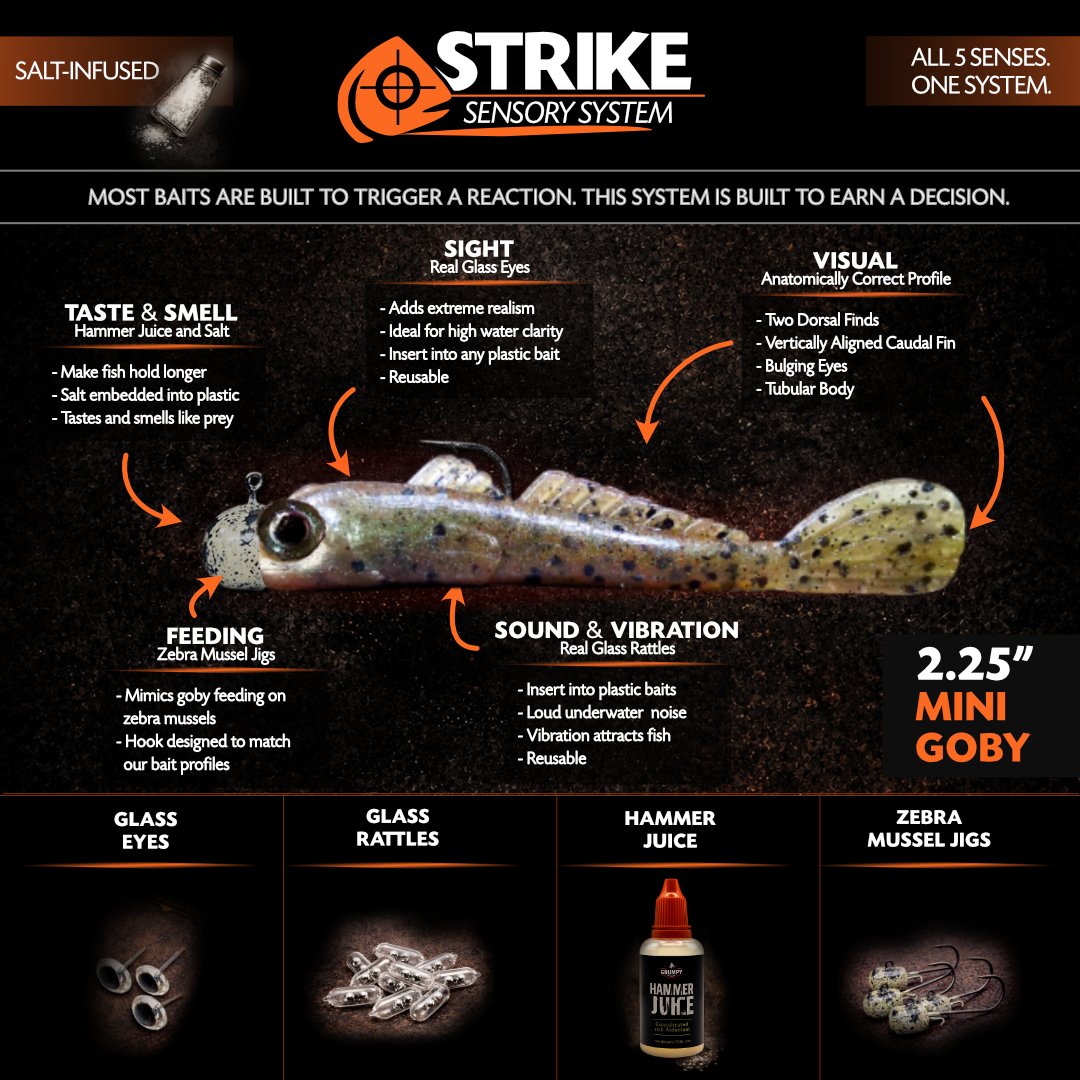
Showing with the 2.25" Mini Goby Clear GRUMPY Glass Eyes, 16mm GRUMPY Rattles, 1/4oz Zebra Mussel Jig

